
As electricity tariffs continue to rise in 2026, solar energy has evolved from an eco-conscious choice into a smart, long-term financial decision. Whether you are a homeowner aiming to reduce monthly power bills or a business looking to achieve energy independence, a well-planned solar PV installation can deliver consistent savings for decades.
This guide explains how to install solar panels step by step, outlines the complete solar panel installation process, and highlights how Solex Energy simplifies the journey with advanced technology and end-to-end expertise.
What Is Solar PV Installation?
Solar PV installation is the setting up of a system that directly uses the most abundant energy source, the sun, and makes it available for people’s consumption. The technology has evolved by 2026, and it uses mainly high, efficiency N, Type TOPCon modules that provide better performance even in low light conditions.
How Solar Panels Work
Solar panels work on the principles of the photovoltaic effect.
Sunlight Absorption: Photovoltaic cells in the solar panels absorb photons from the sun.
Electron Flow: The absorbed photons create an electric field in the PV cells, which is the reason electrons flow and produce Direct Current (DC).
Conversion: The DC electricity goes to an inverter that changes it into Alternating Current (AC), the most common power used by appliances in homes.
Utilization & Storage: The power that is generated may be used directly, stored in a battery, or returned to the grid.
Types of Solar PV Installation Systems
On Grid: The system is connected to the local utility grid. The excess power is exported in exchange for credits through Net Metering.
Off Grid: It is a completely independent system, and therefore, it requires a large battery bank to store energy for use at night. Hybrid: It is a combination of both features, i.e., being connected to the grid and having a battery backup for power outages.
How Solex Energy Makes Your Solar Panel Installation Process Easy and Smooth
Knowing how to install solar panels may be too much for you to handle, but Solex Energy takes the difficulty out of the whole process by providing you with full support from start to finish. Instead of being just a hardware provider, they are your “Solar Partner”.
- Free Expert Consultation: Solex starts with a detailed site survey where experts analyze your roof and energy consumption. This eliminates the guesswork in how to install solar panels step by step for your specific property.
- Hassle-Free Paperwork: One of the most tedious parts of a solar PV installation is the documentation. Solex handles all government subsidy applications and local DISCOM approvals for net-metering on your behalf.
- Precision Engineering: By employing advanced Module Simulation Software, Solex digitally maps your roof to guarantee that panel installations yield 100% shadow-free energy generation.
- One-Stop EPC Service: Solex offers you a single point of contact from system design to final commissioning. This means that your solar PV installation is carried out by a cohesive team of certified professionals, thereby you from the typical delays that result from working with different vendors.
Pre, Pre-Installation Requirements
Site Survey & Roof Measurement
Effective installation starts with a structural audit. Installers measure the available shadow, free area, and verify whether the roof can support the weight of the mounting structure and the panels.
Choosing the Right Solar Panel Capacity
Your system size depends on your monthly unit consumption:
- 1 to 2 kW: Perfect for small homes (approx. 150 units/month).
- 3 to 5 kW: Applicable for average 2–3 BHK households (300–500 units/month).
- 10 kW+: Designed for luxury villas or commercial units.
Checking Roof Direction & Tilt Angle
For maximum yield in India (Northern Hemisphere), panels must face True South.
- Tilt Angle: Generally, the tilt should match your location’s latitude.
- Example: Delhi (~28° N) needs a tilt of 25°–30°, while Chennai (~13° N) needs about 10°–15°.
How to Install Solar Panels Step by Step
Step 1 — Design & Load Calculation
Engineers calculate your peak load to size the inverter and cables. Using Solex Energy’s high-wattage modules allows for a compact design that maximizes limited roof space.
Step 2 — Mounting Structure Installation
Mounting brackets are attached to the roof rafters with screws. In the case of flat roofs, elevated structures are employed to obtain the desired tilt angle. Such structures need to be certified for high wind resistance.
Step 3 — Solar Panel Fixing
The solar modules are attached to the mounting rails using specially designed mid-clamps and end-clamps. A minimal gap is maintained between the panels for air circulation and thermal expansion.
Step 4 — Electrical Wiring & Connection
The panels ae linked with each other through MC4 connectors.
Series Connection: Used for voltage increase.
Parallel Connection: Used for current (amperage) increase.
Weatherproof DC cables are used for the transmission of power from the rooftop to the inverter.
Step 5 — Inverter & Battery Setup
The inverter is placed in a location that has good air circulation. The battery bank, in the case of a hybrid system, is connected here with the help of the local power grid to provide backup during night hours or power outages.
Step 6 — Grid Connection & Net Metering
The installer of your system works closely with the local DISCOM for an on-site bi-directional meter installation.
Metering this way keeps track of the units you export to the grid, which are then subtracted from your monthly bill.
Step 7 — Testing & Commissioning
The time has come for a system review, the last safety check, and earthing included.
Safety Measures in Solar Panel Installation Process
Electrical Safety Instructions
Do not compromise on the insulation of the tools used, and wear protective rubber gloves in order to be safe from electrical shocks. Confirm that the system is earthed correctly and place a lightning arrestor to be safe from surges.
Safety While Working on the Roof
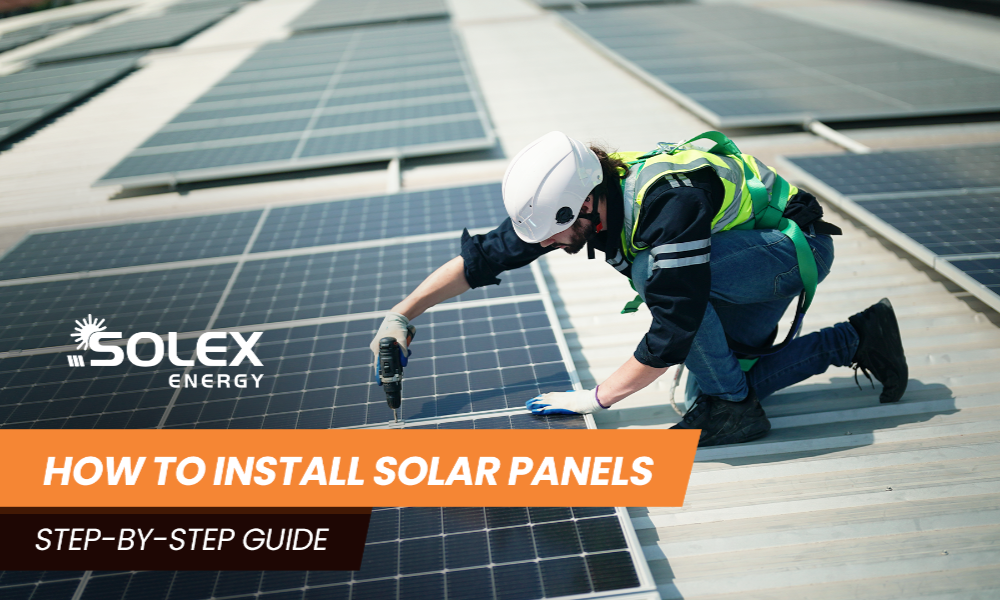
Safety belts and helmets should be worn when working at heights. It is a rule never to do panel installation when it is raining or when there is strong wind.
Professional vs. DIY Solar Panel Installation
When Should You Recruit a Solar Installer?
Although there are small DIY projects, any system that exceeds 1 kW involves high voltage and structural risks. Hence, it is always advisable to hire a professional for either residential or commercial rooftop installations.
Benefits of Professional Installation
Subsidy Eligibility: The government subsidies are only available for installations done by registered vendors.
Warranty Protection: Handling with a professional is the condition that keeps your 30-year warranty valid.
| System Type | Avg. Cost per kW (2026) | ROI Period |
| On-Grid | ₹45,000 to ₹55,000 | 4 to 5 Years |
| Off-Grid | ₹70,000 to ₹1,00,000 | 6 to 8 Years |
Government Subsidies & Approvals
Under the PM Surya Ghar: Muft Bijli Yojana, Indian households can avail:
- A limit of 2 kW: ₹30,000 to ₹60,000 subsidy.
- Exceeding 3 kW: Capped at ₹78,000.
Application: Must be done via the National Rooftop Solar Portal.
Maintenance Tips After Solar PV Installation
Cleaning: Wash panels with plain water every 15 days to remove dust and bird droppings.
Annual Checkups: Have a professional check the wire connections and inverter performance once a year.
Conclusion
A solar system is an asset that lasts for 30 years. Something as insignificant as a mistake during the solar panel installation process, for instance, a poor earthing or a wrong angle, can cause big energy losses with the passage of time. If you decide to go with a high-efficiency technology such as Solex Energy and then perform the installation by taking the steps from this guide, you will, first of all, ensure the highest return on your investment and, at the same time, contribute to a sustainable future.