
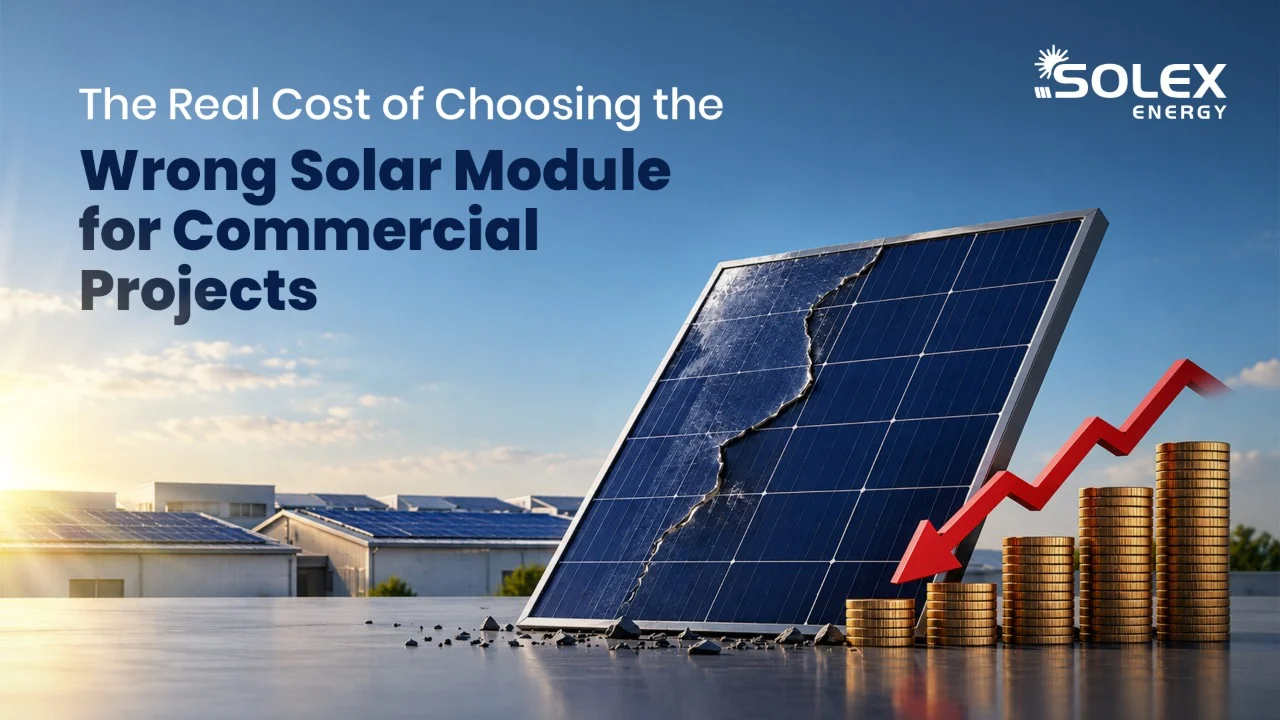
For a commercial solar project, choosing a module is not simply about checking the wattage and comparing prices. A solar plant is expected to operate for decades, which means the module selected today can influence energy generation, maintenance requirements, operating costs, and the overall return on investment for years to come.
This is where Solar Tech becomes an important consideration. Newer module technologies can offer higher efficiency, better temperature performance, lower degradation, and improved energy generation. Choosing a module based only on its initial purchase price can therefore create costs that may not be obvious at the beginning.
The Initial Saving Can Become a Long-Term Expense
When commercial projects are being planned, budget pressure is understandable. However, selecting a lower-cost module without studying its specifications can affect the economics of the entire plant.
A module may have an attractive upfront price but deliver lower energy under actual site conditions. Over a large commercial installation, even a small difference in energy output can become significant over time.
The real cost of a module should therefore include:
- Expected lifetime energy generation
- Module degradation
- Performance in high temperatures
- Efficiency and available installation area
- Warranty coverage
- Maintenance and replacement requirements
- Long-term reliability
A slightly higher initial investment can sometimes make sense when the module provides better long-term performance.
Poor Module Selection Can Reduce Energy Generation
Commercial rooftops often have limited usable space. This makes module efficiency particularly important.
If a business has a fixed roof area, installing lower-efficiency modules may mean generating less electricity from the same available space. Alternatively, additional modules and supporting infrastructure may be required to reach the desired capacity.
High-efficiency commercial solar modules can help businesses make better use of limited installation areas. Solex Energy, for example, offers N-Type TOPCon modules designed for high-power generation and space-efficient installations. Its Tapi-R series is listed with power ratings up to 625 Wp and module efficiency up to 23.14%.
Heat Can Have a Bigger Impact Than Expected
These Indian commercial & industrial spaces are subjected to prolonged high temperatures. These modules are also based outdoors. As a result, their performance is affected by heat.
Thus, the temperature coefficient can be a key specification that should be considered when choosing a module. This also helps reduce power losses as the module temperature increases.
This is very true for any plant, warehouse, industrial building, commercial building or large rooftop installation where energy generation needs to be consistent.
Solex’s N-Type TOPCon Tapi-R modules, for instance, are designed with a low power temperature coefficient and are positioned for demanding operating conditions.
Degradation Matters Over the Life of the Project
Power Generations from a solar module do not remain constant over its service life. When estimating long-term power generation, the power degradation rate of a solar module needs to be taken into account.
An insignificant percentage difference in degradation over one year may appear to be over several decades when the net amount of electricity generated by the plant is considered.
Before selecting a module, businesses should examine:
- First-year degradation
- Annual degradation after the first year
- Performance warranty period
- Product warranty
- Conditions attached to the warranty
Solex’s published Tapi-R information includes a 12-year product warranty and a 30-year linear performance warranty, giving project owners a defined framework for long-term module performance.
Reliability Is More Than a Technical Specification
A commercial solar installation is a long-term infrastructure investment. Module reliability affects not only generation but also maintenance planning and business continuity.
Therefore, quality in manufacture, testing, certification and uniform standards of production should be factored into the decision when buying. Consideration should be given as to whether the company can provide the necessary backup and technical support for any post installation problems.
Solex Energy has focused its manufacturing capacity on automated manufacturing and quality inspection and also offers a range of products, including N-Type TOPCon and dual-glass systems, targeted at the commercial, industrial and utility markets.
Look Beyond the Price Tag
Choosing the right module will require some analysis of the economics of the whole project rather than selecting purely on the lowest purchase price.
The correct Solar Tech understands the importance of efficiency, reliability, longevity and environmental impact, degradation, warranties, and production expectations. When you are applying these to your commercial project, all of them are likely to affect the profitability of your project for years to come.
Solex Energy brings module manufacturing and solar EPC together. By partnering with us, a business can leverage expertise that understands the technology and can ensure project delivery.
You won’t notice this on the day the wrong module is installed. Yet, at the end of the day, the true cost can be measured in lost power output, lower energy production, less efficient roof space utilisation or higher maintenance costs.
When it comes to commercial projects, the purchase of commercial solar modules must be regarded as a strategic decision made with a broader vision and planning rather than just buying and bidding. With quality modules, warranties, technology and production, and execution with best standards in the actual operating environment, the solar plant can create trusted value in the coming decades.
FAQs
1. Why is choosing the right solar module important for commercial projects?
The right module can improve energy generation, reduce losses, support reliability, and deliver better long-term project returns.
2. How does module efficiency affect commercial solar projects?
Higher-efficiency modules can generate more electricity from limited roof space, helping commercial properties maximise available installation areas.
3. Why should businesses consider solar module degradation?
Module degradation gradually reduces power output. Lower degradation can help maintain stronger energy generation throughout the project’s operating life.
4. What should businesses consider besides solar module price?
Businesses should consider efficiency, temperature performance, degradation, warranties, reliability, maintenance requirements, certifications, and long-term energy yield.